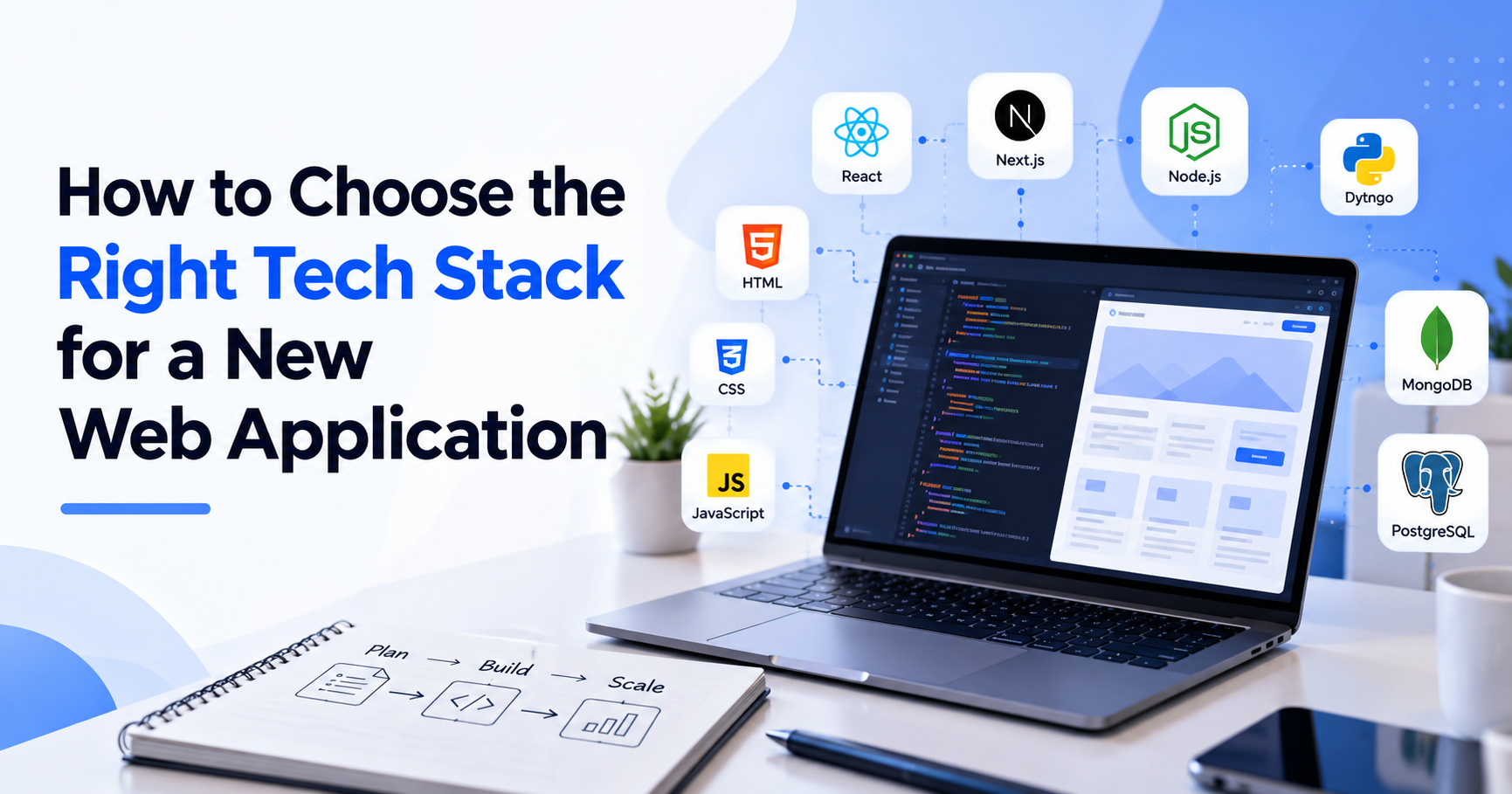
Building a web application starts with an idea, but turning that idea into a reliable product requires the right technology. Choosing a tech stack is one of the most important decisions in web development because it affects performance, scalability, security, development costs, and future maintenance.
With so many programming languages, frameworks, and databases available, selecting the right combination can feel overwhelming. The good news is that you do not need the most popular or advanced technologies to build a successful application. You need the ones that fit your project's requirements.
In this article, we will explore how to choose the right tech stack for a new web application and which factors developers should consider before making a decision.
What Is a Tech Stack?
A tech stack is a combination of technologies used to develop and run a web application. It generally includes frontend technologies, backend technologies, a database, and supporting tools.
The main components include:
- Frontend: The part of the application users see and interact with. Common technologies include HTML, CSS, JavaScript, React, and Next.js.
- Backend: Handles business logic, authentication, APIs, and server-side operations. Popular choices include Node.js, Django, Laravel, and ASP.NET Core.
- Database: Stores and manages application data. Examples include PostgreSQL, MySQL, and MongoDB.
- Infrastructure and deployment: Services and tools used to host, deploy, monitor, and maintain the application.
Each component plays a different role, so the best tech stack depends on how these technologies work together.
1. Understand Your Project Requirements
Before choosing technologies, define what your application needs to accomplish.
A simple business website has different requirements from an e-commerce platform, SaaS product, or real-time communication application.
Ask yourself a few questions:
- What problem will the application solve?
- Who will use it?
- What features are essential for the first version?
- Will it handle payments, user accounts, or sensitive information?
- How much traffic do you expect?
For example, a content-focused website may benefit from a framework with strong rendering and SEO capabilities. An application with real-time notifications may require technologies that support persistent connections and efficient event handling.
Starting with clear requirements helps you avoid unnecessary complexity and development expenses.
2. Choose the Right Frontend Technology
The frontend directly affects the user experience, accessibility, and responsiveness of your application.
React is a popular option for building interactive user interfaces using reusable components. It is suitable for dashboards, SaaS products, and applications with complex interfaces.
Next.js builds on React and provides features such as server-side rendering, static generation, and routing. It can be particularly useful for applications that need good performance and search engine visibility.
Vue.js is another option for developers who prefer an approachable framework for building interactive interfaces.
When making your choice, consider the complexity of your interface, rendering requirements, team experience, and long-term maintenance needs.
3. Select a Backend That Fits Your Application
The backend processes requests, manages business logic, connects to databases, and supports features such as authentication and payments.
Here are some common options:
- Node.js: Useful for API-driven applications, JavaScript-based development teams, and many real-time use cases.
- Django: A Python framework that provides built-in features for common backend requirements.
- Laravel: A PHP framework with tools for routing, database operations, authentication, and application development.
- ASP.NET Core: A strong option for enterprise applications and systems that require integration with Microsoft technologies.
There is no universally best backend. Choose one that supports your functional requirements, security needs, development timeline, and team's technical skills.
4. Pick a Suitable Database
Your database should match the way your application stores and processes information.
PostgreSQL is a relational database suitable for structured data, complex queries, and applications that need strong data integrity.
MySQL is another established relational database commonly used for websites and business applications.
MongoDB stores data in flexible documents, which can be useful when the application's data structure varies.
For example, an online store typically benefits from carefully structured relationships between products, customers, orders, and payments. A document-oriented database may be appropriate for applications that work with flexible or nested data.
Evaluate data relationships, transaction requirements, query patterns, and future reporting needs before deciding.
5. Consider Scalability and Performance
Your application may start with a small user base and grow over time. The technology stack should support that growth without requiring an unnecessary rebuild.
Consider factors such as:
- Expected traffic and concurrent users
- API response times and database performance
- Caching and background processing requirements
- Cloud hosting and deployment options
- Monitoring and error-handling capabilities
Remember that scalability is not determined by the technology stack alone. Database design, application architecture, caching, infrastructure, and code quality also play important roles.
For many projects, a well-structured monolithic application is a sensible starting point. Microservices can be introduced when the system's complexity and operational requirements justify them.
6. Prioritise Security From the Beginning
Security should be part of the initial development plan, not something added after launch.
Choose technologies with reliable security updates and established practices. Implement appropriate authentication, access controls, input validation, secure session management, and data encryption where needed.
You should also protect API endpoints, manage secrets securely, keep dependencies updated, and test for common vulnerabilities.
If your application handles payments or sensitive customer information, review the relevant security and compliance requirements before development begins.
7. Evaluate Development Costs and Team Expertise
A technology may look attractive on paper but still be a poor choice if it significantly increases development time or maintenance costs.
Consider the availability of experienced developers, documentation, community support, third-party libraries, hosting expenses, and ongoing updates.
Using technologies your team already understands can help speed up development. However, the decision should also account for long-term project needs rather than relying entirely on familiarity.
Businesses working with an external development team should discuss technical recommendations, maintenance plans, and expected infrastructure costs before finalising the stack.
8. Start With a Practical Tech Stack
For many modern web applications, the following combination can be a useful starting point:
- Frontend: React or Next.js
- Backend: Node.js
- Database: PostgreSQL
- API: REST or GraphQL, depending on requirements
- Hosting: A suitable cloud platform based on performance, budget, and operational needs
- Version control: Git
This is not a one-size-fits-all solution. A Python-based backend, Laravel application, or different database may be a better fit for specific projects.
The goal is to choose technologies that work well together and solve your application's actual problems.
Final Thoughts
Choosing the right tech stack is an important step toward building a secure, maintainable, and scalable web application.
Start by defining your requirements, selecting suitable frontend and backend technologies, evaluating your database needs, and considering security, performance, budget, and team expertise.
Most importantly, keep your architecture as simple as possible while meeting your current requirements. You can introduce more advanced technologies as your application grows and its needs become clearer.
A thoughtful technology decision at the beginning can make development smoother and help your application adapt to future business opportunities.
About the author
- I write about iOS development, mobile networking, developer tools, software engineering, and emerging technologies. My goal is to turn complex technical concepts into practical, easy-to-understand content for developers.
Comments
Join the discussionNo comments yet. Be the first to comment.