Build vs Buy: When Should a Business Invest in Custom Software?
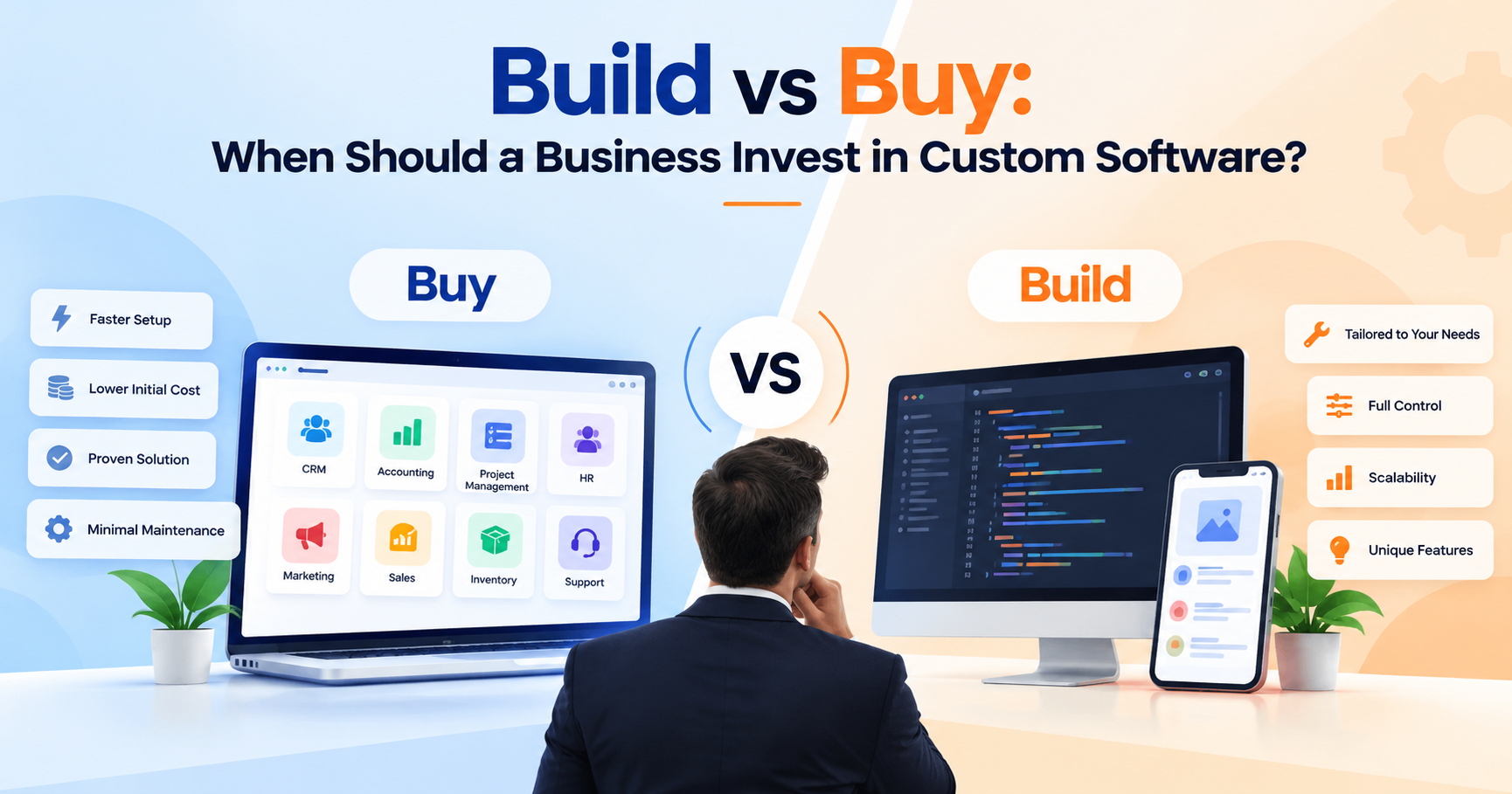
Every growing business eventually faces an important technology decision: should it purchase an existing software solution or invest in building custom software?
Off-the-shelf software can help businesses get started quickly, while custom software offers greater control over features, workflows, and future development. However, neither option is automatically the right choice.
The best decision depends on your business requirements, operational complexity, budget, and long-term growth plans.
In this article, we will explore the differences between building and buying software, the advantages and limitations of each approach, and how to determine which option makes sense for your business.
What Is the Difference Between Building and Buying Software?
Buying software means subscribing to or purchasing an existing product that provides predefined features. Examples include CRM platforms, accounting tools, project management applications, and inventory management systems.
Building custom software means developing a solution specifically designed around your business processes, customer requirements, and operational goals.
For example, a small company might use an existing CRM to manage customer relationships. However, a business with a complex sales process, specialised reporting requirements, and multiple system integrations might benefit from a custom CRM solution.
The key difference is flexibility. Purchased software works within the capabilities of an existing product, while custom software can be designed around the way your business operates.
Build vs Buy: A Quick Comparison
| Factor | Buy Existing Software | Build Custom Software |
|---|---|---|
| Initial investment | Usually lower | Usually higher |
| Time to launch | Generally faster | Requires development time |
| Customisation | Limited to available options | Designed around specific needs |
| Integrations | Depends on supported integrations | Can be tailored to requirements |
| Maintenance | Often handled by the vendor | Requires an internal team or development partner |
| Scalability | Depends on the product and pricing plan | Can be planned around growth requirements |
| Ownership and control | Governed by vendor terms | Depends on the contract and IP arrangements |
Buying is often more practical for standard business functions. Building becomes more attractive when existing tools cannot adequately support important business processes.
When Should a Business Buy Existing Software?
Buying software is often the most sensible option when your requirements are common, and existing products can meet them effectively.
1. Your Requirements Are Standard
If your business needs basic accounting, email marketing, employee scheduling, or project management capabilities, an established product may already provide everything you need.
Developing these features from scratch could introduce unnecessary costs and complexity.
2. You Need a Solution Quickly
Ready-made software can often be configured and deployed much faster than a custom application.
This is particularly useful for startups validating a business idea or companies that need to solve an immediate operational problem.
3. Your Budget Is Limited
Subscriptions typically require less upfront investment than a full software development project. This allows smaller businesses to access useful technology without hiring a development team or managing a large implementation.
However, remember to evaluate recurring subscription charges, additional user fees, premium integrations, and future price increases.
4. Existing Products Meet Your Needs
If a commercially available product already supports your workflows, reporting, integrations, and security requirements, building a replacement may offer little additional value.
In such cases, purchasing software allows your team to focus on business growth rather than maintaining another technology platform.
When Should a Business Invest in Custom Software?
Custom software becomes worth considering when technology limitations begin affecting productivity, customer experience, or competitive advantage.
1. Your Business Has Unique Workflows
Some businesses operate with processes that standard software cannot easily accommodate.
For example, a logistics company may require specialised shipment allocation, route planning, delivery tracking, and billing workflows that connect several internal systems.
Custom software can bring these processes together in a single platform designed around the company's actual operations.
2. Existing Tools Create Integration Problems
Using multiple disconnected applications can lead to duplicate data entry, inconsistent reporting, and manual work.
Custom software or a tailored integration layer can connect systems such as CRM platforms, payment gateways, inventory tools, and internal databases.
Before building an entirely new platform, however, evaluate whether APIs, middleware, or existing integration products can solve the problem more economically.
3. You Need Greater Control Over Product Features
Businesses developing differentiated services or digital products may require features that competitors cannot easily replicate using standard software.
A custom platform can provide greater control over product functionality, user experience, release schedules, and future enhancements.
For example, a startup launching a specialised subscription platform may need custom billing rules, customer dashboards, role-based access, and integrations with external services.
4. Software Limitations Are Slowing Growth
As a company expands, its operational requirements may become more complex.
A tool that works for a small team may struggle to support multiple business units, complex permissions, high transaction volumes, or advanced reporting.
Custom software can address these limitations when its expected benefits justify the investment. The architecture must still be designed, tested, and maintained to handle future growth.
5. You Want to Create a Digital Product
Custom development is particularly relevant when software is itself part of your business offering.
Examples include:
SaaS platforms for a specific industry
Customer-facing mobile applications
Online marketplaces
Booking and appointment platforms
Industry-specific management systems
AI-powered business applications
In these situations, the software may help generate revenue, improve customer retention, or differentiate the business in its market.
How to Evaluate the Total Cost of Ownership
One of the biggest mistakes businesses make is comparing only the initial development cost with the price of a software subscription.
A more useful approach is to calculate the total cost of ownership (TCO) over a period such as three to five years.
For purchased software, consider:
Subscription and licensing fees
Implementation and configuration
Integration costs
Training and onboarding
Additional user or usage charges
Data migration and potential vendor switching costs
For custom software, consider:
Discovery, design, and development
Testing and deployment
Cloud hosting and infrastructure
Security updates and maintenance
Future feature development
Technical support and internal resources
Custom software generally involves more upfront planning and development, but it may deliver better long-term value when it eliminates significant manual work or supports a revenue-generating product.
The outcome depends on the actual requirements, implementation quality, adoption, and ongoing operating costs.
A Practical Example: Build or Buy for an E-Commerce Business
Imagine an e-commerce company using separate tools for inventory, order management, customer communication, and accounting.
Initially, these tools may be sufficient. As order volumes increase, employees might spend hours reconciling stock levels, updating order statuses, and transferring information between systems.
The business has three possible approaches:
Option 1: Continue buying existing tools. This works if the current products can support the business with minimal manual intervention.
Option 2: Integrate the existing tools. APIs or integration platforms may eliminate repetitive tasks without requiring a complete custom application.
Option 3: Build a custom operational platform. This may be justified when workflows are highly specialised, existing integrations are insufficient, or the business needs a unified system to support its growth.
The right decision is not necessarily to replace every existing tool. A hybrid approach—combining commercial software with custom applications and integrations—may provide the best balance between cost, flexibility, and functionality.
A Simple Framework for Making the Decision
Before committing to a development project, ask these five questions:
Can existing software solve the problem? Evaluate available products before deciding to build.
Is the problem strategically important? Consider whether it affects customer experience, operational efficiency, or revenue.
What is the real cost of the current limitations? Estimate wasted employee hours, errors, lost opportunities, and recurring expenses.
Will the solution need to evolve? Consider future features, integrations, user growth, and changing business requirements.
Can we support the software long term? Establish a realistic budget and plan for maintenance, security, and technical ownership.
If existing software meets your requirements at a reasonable cost, buying is usually the simpler option. If its limitations repeatedly affect important business outcomes, custom development deserves a closer evaluation.
How a Custom Software Development Partner Can Help
Choosing between building and buying does not always require an immediate commitment to custom development.
An experienced software development partner can assess your current systems, identify operational gaps, evaluate integration opportunities, and recommend an appropriate technical approach.
For example, LoudOwls can be considered by businesses exploring custom software and digital product development. Before selecting a provider, evaluate its relevant portfolio, technical capabilities, proposed architecture, delivery process, project estimates, and post-launch support.
A useful discovery process should establish:
The business problem and desired outcomes
The essential features for an initial release
The systems that need to be integrated
The expected development and operating costs
The approach to security, maintenance, and future improvements
This helps businesses avoid investing in unnecessary features and focus on solutions that address measurable needs.
Final Thoughts
The build-versus-buy decision is not simply about choosing between expensive custom development and affordable ready-made software. It is about finding the most practical way to support your business goals.
Buy existing software when your needs are standard, time is limited, and established products can deliver the required functionality.
Invest in custom software when specialised workflows, integration challenges, product differentiation, or growth requirements make existing solutions inadequate.
In many cases, the best strategy combines both approaches: use established tools where they work well and invest in custom development where it creates meaningful business value.
The goal is not to build more software. It is to choose technology that solves the right problems, supports growth, and delivers measurable returns.