Mobile app development is more than writing code and creating attractive interfaces. Building an application that performs smoothly, handles real-world user demands, and grows with a business requires careful planning and technical decisions.
However, developers often overlook important aspects during development. These mistakes may not seem serious initially, but they can lead to performance issues, security risks, poor user experiences, and expensive updates later.
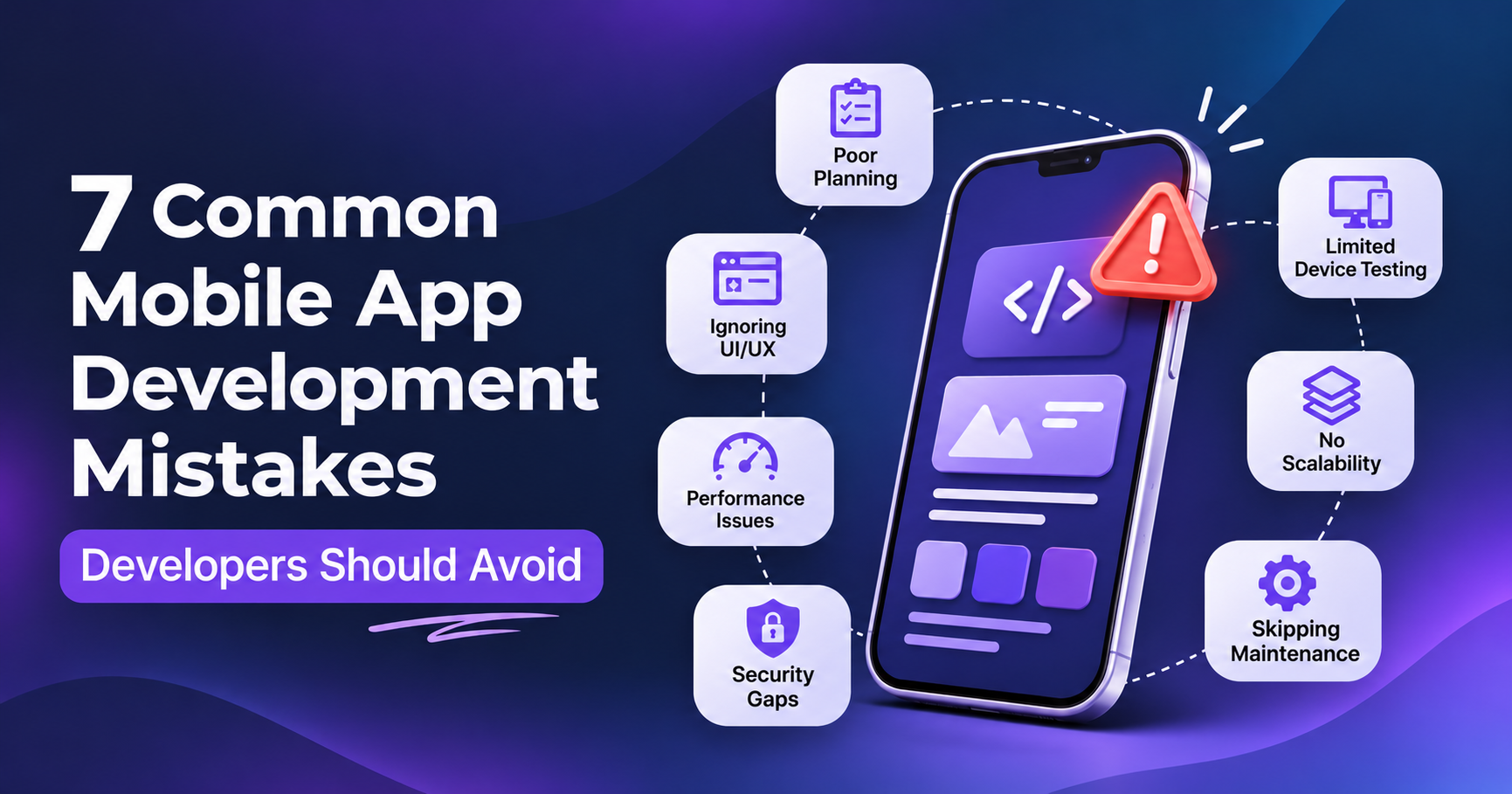
Let's explore seven common mobile app development mistakes developers should avoid.
1. Skipping Proper Planning and Requirement Analysis
One of the biggest mistakes is starting development without clearly understanding the project requirements.
Developers sometimes focus on building features without considering the application's purpose, target audience, or business objectives. This can result in unnecessary functionality, changing requirements, and development delays.
How to avoid it:
- Define the application's primary objectives.
- Identify the target audience.
- Prepare a clear feature list.
- Create user flows and technical documentation.
- Prioritize essential features before development.
A well-defined development plan helps reduce confusion and keeps the project on track.
2. Ignoring UI/UX Design
An application may have excellent functionality, but users will struggle to use it if the interface is confusing.
Complicated navigation, inconsistent layouts, slow interactions, and overcrowded screens can negatively affect user engagement.
How to avoid it:
- Keep navigation simple and intuitive.
- Maintain consistent design elements.
- Follow platform-specific design guidelines.
- Test designs with real users.
- Make accessibility a priority.
Good UI/UX design makes applications easier to understand and encourages users to return.
3. Neglecting Application Performance
Performance is one of the most important factors influencing mobile app success.
Slow loading screens, delayed API responses, excessive memory usage, and frequent crashes can frustrate users. Even a well-designed application can lose users if it does not perform reliably.
How to avoid it:
- Optimize images and other media files.
- Reduce unnecessary background processes.
- Monitor memory and CPU usage.
- Optimize API requests.
- Test performance across different devices and network conditions.
Developers should evaluate performance throughout the development process rather than waiting until launch.
4. Overlooking Application Security
Mobile applications often process sensitive information, including personal details, payment information, and account credentials.
Ignoring security during development can expose applications to data breaches, unauthorized access, and other vulnerabilities.
How to avoid it:
- Use HTTPS for secure communication.
- Implement secure authentication.
- Encrypt sensitive information.
- Validate user inputs.
- Protect API endpoints.
- Conduct regular security testing.
Security should be considered from the beginning of development, not added as an afterthought.
5. Not Testing Across Different Devices
An application that works perfectly on one device may behave differently on another.
Different screen sizes, operating system versions, hardware capabilities, and network conditions can create unexpected issues.
How to avoid it:
- Test on multiple screen sizes.
- Check compatibility across OS versions.
- Perform real-device testing.
- Test different network conditions.
- Include functional and regression testing.
Thorough testing helps developers identify compatibility problems before users experience them.
6. Building an Application Without Scalability in Mind
Many applications are initially designed for a small user base. However, as downloads and user activity increase, the existing architecture may struggle to handle the additional workload.
Poor database design, tightly coupled components, and inefficient backend services can make future expansion difficult.
How to avoid it:
- Choose an appropriate application architecture.
- Design efficient database structures.
- Use scalable backend infrastructure.
- Optimize API communication.
- Plan for future integrations and features.
Thinking about scalability early can save significant development time and costs in the future.
7. Ignoring Post-Launch Maintenance
Launching an application is not the end of the development journey.
Operating systems receive updates, security vulnerabilities emerge, and user expectations change. Without regular maintenance, applications can gradually become outdated or unreliable.
How to avoid it:
- Monitor application crashes.
- Fix reported bugs regularly.
- Release security updates.
- Collect and analyze user feedback.
- Improve features based on actual usage.
Continuous improvement helps maintain application quality and user satisfaction.
Final Thoughts
Successful mobile app development requires more than technical knowledge. It involves thoughtful planning, user-focused design, strong security, performance optimization, and continuous improvement.
Avoiding these seven common mistakes can help developers create applications that are reliable, secure, scalable, and easier to maintain.
LoudOwls believes that building a successful mobile application starts with understanding the problem, choosing the right technology, and creating solutions that deliver real value to users. A well-built application is not just one that works today; it is ready for tomorrow.
About the author
- I write about iOS development, mobile networking, developer tools, software engineering, and emerging technologies. My goal is to turn complex technical concepts into practical, easy-to-understand content for developers.
Comments
Join the discussionNo comments yet. Be the first to comment.